
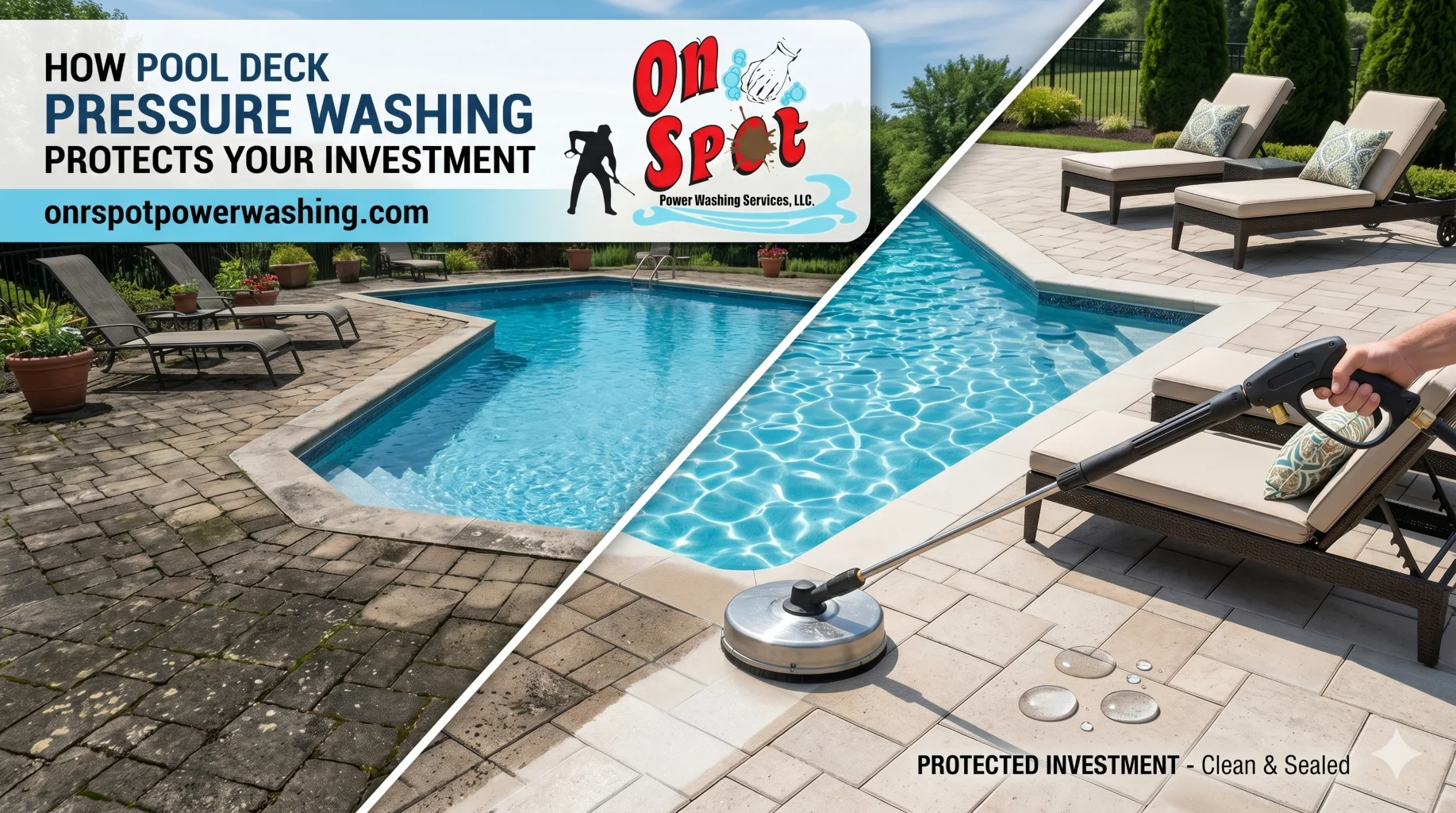
A swimming pool is one of the most significant investments a homeowner in Fort Bend County, Texas can make. The pool itself typically costs $30,000 to $80,000+ to install — but the pool deck surrounding it represents an additional $5,000 to $20,000 in concrete, pavers, natural stone, or travertine. That’s a substantial investment sitting outdoors in one of the most demanding climates in the country, exposed to year-round heat, humidity, pool chemicals, and constant foot traffic.
Most Fort Bend County homeowners maintain their pool water chemistry meticulously. But the deck surrounding the pool — the surface that every swimmer steps onto, that children run across, that guests see first when they walk into your backyard — receives far less attention. And in Texas’s subtropical climate, that oversight accelerates deterioration, creates safety hazards, and shortens the lifespan of an expensive surface far faster than most homeowners expect.
Professional pool deck pressure washing isn’t just about appearance. It’s one of the most cost-effective maintenance investments you can make for one of the most expensive outdoor features of your home.
Why Pool Decks Face Unique Threats in Fort Bend County
A pool deck operates in a uniquely hostile environment compared to other exterior surfaces. The combination of constant moisture, pool chemicals, bare feet, UV exposure, and Fort Bend County’s climate creates a perfect storm of deterioration factors that no other surface in your home faces simultaneously.
🏊 The Fort Bend County Pool Deck Reality
Fort Bend County’s average pool season runs 10 months out of the year — and the remaining 2 months still see enough warmth and humidity to keep biological growth active on pool decks. Compared to northern states where cold winters reset biological growth each year, Texas pool decks accumulate contamination and biological damage continuously with no seasonal reset.
Green and Black Algae
The most common and visible pool deck threat in Fort Bend County. Green algae thrives in the consistently wet conditions around pools. Black algae — a significantly more aggressive organism — embeds root systems directly into porous concrete and natural stone. Both create dangerously slippery surfaces and produce organic acids that chemically attack the concrete or stone material beneath.
Pool Chemical Residue
Chlorine, algaecides, and pH adjustment chemicals are necessary for pool water safety — but they’re also caustic to pool deck surfaces. Splashing, overflow during storms, and wet swimsuits tracking chemical-laden water across the deck create a slow but continuous chemical attack on unsealed concrete, natural stone, and grout joints. Over years, this accelerates surface erosion and staining.
UV and Heat Damage
Texas’s intense sun causes thermal expansion and contraction cycles in pool deck materials — particularly in concrete and pavers — that develop micro-cracks over time. These cracks become entry points for biological growth, water infiltration, and chemical penetration. UV exposure also degrades sealers faster in Texas than in any other major metropolitan climate in the US.
Storm and Hurricane Debris
Fort Bend County’s active storm season deposits organic debris — leaves, soil, pollen, and organic matter — on pool decks during every significant rain event. This organic material is an ideal growth medium for algae and mold when combined with residual pool moisture and Texas heat. Post-storm pool decks that aren’t cleaned promptly see biological growth establish significantly faster.
6 Ways Pressure Washing Protects Your Pool Deck Investment
Eliminates Slip-and-Fall Hazards
This is the most immediate and important benefit. Algae and biological growth on a wet pool deck creates one of the most dangerous slip-and-fall surfaces imaginable — the combination of water, bare feet, and biological film is genuinely hazardous. Texas property owners carry legal liability for injuries on their premises when hazardous conditions are known or should have been known. A visibly green or slimy pool deck is exactly that. Professional pressure washing removes the biological growth that creates these conditions — making your pool area safe for family, guests, and children.
Prevents Biological Acid Etching of the Surface
Algae and mold produce organic acids as metabolic byproducts. Over time, these acids etch microscopic pits into concrete, travertine, natural stone, and pavers — increasing surface porosity and making the material more susceptible to future staining and biological colonization. This is a compounding process: each cleaning cycle that is skipped makes the next contamination worse and the next cleaning more difficult. Regular professional cleaning interrupts this cycle before permanent surface degradation occurs.
Protects Sealers and Extends Resealing Intervals
Most pool decks should be sealed every 2 to 4 years depending on material and exposure. But a pool deck that accumulates biological growth, chemical residue, and organic buildup between sealings degrades its sealer significantly faster. Regular pressure washing removes the abrasive contamination that physically wears down sealer coatings — extending the protective window of each sealing application and reducing your long-term sealer costs.
Maintains Outdoor Living Space Value and Appearance
Your pool deck is the visual centerpiece of your outdoor living space. In Fort Bend County’s competitive real estate market, a clean, well-maintained pool area is a significant selling point — and a neglected, algae-covered deck is an immediate red flag for buyers and appraisers. Real estate professionals consistently report that outdoor living spaces in excellent condition add measurably more to sale prices than comparable homes with neglected pool areas.
Removes Organic Material Before It Penetrates Deeper
Organic contamination — algae, mold, leaf tannins, sunscreen residue, and storm debris — begins penetrating porous concrete and natural stone within days of deposition in Texas’s heat. The longer it sits, the deeper it goes. Professional pressure washing removes contamination from the surface and upper pores of the material before it reaches the depth where only chemical treatment or resurfacing can address it. Prompt, regular cleaning is always more effective than catch-up cleaning.
Dramatically Reduces Long-Term Repair and Replacement Costs
Pool deck resurfacing costs $3,000 to $8,000 for a typical Fort Bend County residential pool. Full deck replacement runs $8,000 to $25,000+ depending on material. Regular professional cleaning at $100 to $350 every 6 to 12 months protects this investment by preventing the biological acid etching, chemical damage, and structural deterioration that leads to premature resurfacing. The math consistently favors regular maintenance over reactive repairs.
Which Pool Deck Surfaces Need Different Cleaning Approaches?
Not all pool deck surfaces are cleaned the same way. Fort Bend County pool decks come in a variety of materials, and the appropriate pressure and technique varies significantly by surface type:
| Surface Type | Recommended Method | PSI Range | Key Considerations |
|---|---|---|---|
| Standard concrete (broom finish) | ✅ Pressure washing | 1,500–2,500 PSI | Most durable surface — handles standard pressure well. Use surface cleaner attachment for even results. |
| Exposed aggregate concrete | ✅ Pressure washing | 1,200–2,000 PSI | Lower pressure recommended to avoid dislodging aggregate pieces from the surface. |
| Concrete pavers | ✅ Pressure washing | 1,000–1,800 PSI | Avoid directing pressure at mortar/sand joints to prevent washout. Re-sand joints after cleaning if needed. |
| Travertine | 💧 Low-pressure / soft wash | 500–800 PSI | Travertine is porous and softer than concrete — high pressure can pit and etch the surface permanently. |
| Natural stone (limestone, slate) | 💧 Low-pressure / soft wash | 400–700 PSI | Natural stone varies widely in hardness. Professional assessment required — wrong pressure can cause irreversible damage. |
| Stamped or decorative concrete | ⚠ Moderate pressure | 800–1,500 PSI | Protective sealers on stamped concrete can be stripped by excessive pressure. Lower PSI preserves the sealer coating. |
| Painted concrete | ⚠ Moderate pressure | 600–1,200 PSI | High pressure will strip paint. Use lower settings and wide-angle nozzles. Test in inconspicuous area first. |
How Often Should You Clean Your Pool Deck in Texas?
Fort Bend County’s climate and pool usage patterns create a specific maintenance calendar that differs significantly from the national average:
Spring
March · April · May
Full professional cleaning before pool season opens. Removes winter buildup and pollen season residue. Ideal time to reseal if due.
✅ Pre-Season EssentialSummer
June · July · August
Mid-season light cleaning if heavy usage. Black algae establishes fast in peak heat — address immediately if spotted. Morning scheduling recommended.
⚠️ As Needed / Spot CleanFall
September · October · November
Full professional cleaning after peak season. Removes summer buildup, sunscreen residue, and storm debris before cooler months. Most important annual cleaning.
✅ Post-Season EssentialWinter
December · January · February
Light maintenance as needed. Fort Bend County’s mild winters still allow biological growth — inspect monthly and address any visible growth promptly.
ℹ️ Monitor & Maintain💡 The Optimal Fort Bend County Pool Deck Schedule
For most Fort Bend County homes, two professional cleanings per year — one in spring before pool season opens (March/April) and one in fall after peak season ends (October/November) — is the minimum recommended maintenance cycle. Homes with heavy tree coverage, enclosed pool areas, or black algae history may benefit from quarterly professional cleaning to prevent re-establishment.
Signs Your Pool Deck Needs Immediate Professional Cleaning
- Any visible green discoloration on the deck surface — even a faint tinge signals active algae colonization
- Black spots or patches — black algae requires immediate attention as it embeds root systems quickly in porous surfaces
- Surface feels slippery when wet even when there’s no visible growth — biofilm can be present before visible discoloration appears
- White chalky or crusty deposits around pool edges or drain areas — calcium and mineral deposits from pool chemistry that etch surfaces over time
- Brown or orange staining near metal fixtures, pool equipment areas, or tree debris — tannins and rust stains that penetrate porous surfaces rapidly
- Post-storm organic debris sitting on the deck for more than 24 hours — leaf tannins and organic matter stain and feed biological growth quickly in Texas heat
- It has been more than 6 months since the last professional cleaning — in Fort Bend County’s climate, 6 months is the maximum reasonable interval
✅ The Investment Protection Summary
A pool deck that costs $10,000 to $20,000 to install deserves professional cleaning at $100–$350 every 6–12 months. That’s a maintenance investment of $200–$700 per year to protect a surface that costs $3,000–$8,000 to resurface and $8,000–$25,000 to replace. Regular cleaning doesn’t just maintain your pool deck’s appearance — it actively extends its functional lifespan, reduces liability exposure, preserves sealer effectiveness, and protects one of the most visible and valuable features of your Fort Bend County home.
Frequently Asked Questions
In Fort Bend County and the greater Houston area, pool decks should be professionally pressure washed every 6 to 12 months. Pool decks accumulate algae, mold, sunscreen residue, and chemical buildup faster than other outdoor surfaces because of constant moisture exposure, Texas's year-round heat, and high humidity. Pool decks used heavily during summer months or surrounded by trees may need cleaning every 3 to 6 months.
Not all pool deck surfaces should be pressure washed at the same pressure settings. Concrete and pavers handle standard pressure washing well. Natural stone, travertine, and textured surfaces require lower pressure to avoid etching or damaging the surface profile. Painted or sealed concrete should also use lower pressure to preserve the coating. A professional contractor will adjust pressure and technique based on the specific surface type.
Green discoloration on pool decks is caused by algae, which thrives in the consistently warm, wet conditions around pools in Fort Bend County's climate. Black staining is typically caused by mold or black algae — a particularly aggressive organism that embeds root systems into porous concrete. Both create slippery, hazardous surfaces and chemically attack the concrete over time if left untreated.
Pressure washing done incorrectly — with too much pressure, wrong nozzle angles, or on inappropriate surfaces — can damage pool decks by etching concrete, stripping sealers, or dislodging mortar in paver joints. Professional technicians use surface-appropriate pressure settings, correct nozzle types, and proper technique to clean effectively without causing damage. For natural stone and textured surfaces, soft washing or low-pressure cleaning is the recommended approach.
Professional pool deck pressure washing in the Richmond TX and Fort Bend County area typically costs $100 to $350 depending on the size of the deck, surface material, and level of buildup. Many homeowners save money by bundling pool deck cleaning with driveway or house washing in a single visit. On Spot Power Washing provides free estimates — call 832-338-0018 or request online at onspotpowerwashing.com.
Ready to Protect Your Pool Deck Investment?
On Spot Power Washing provides professional pool deck cleaning throughout Richmond, Sugar Land, Katy, Cinco Ranch, and all of Fort Bend County. Surface-appropriate techniques, fully insured, free estimates.
📞 Call now: (832) 338-0018