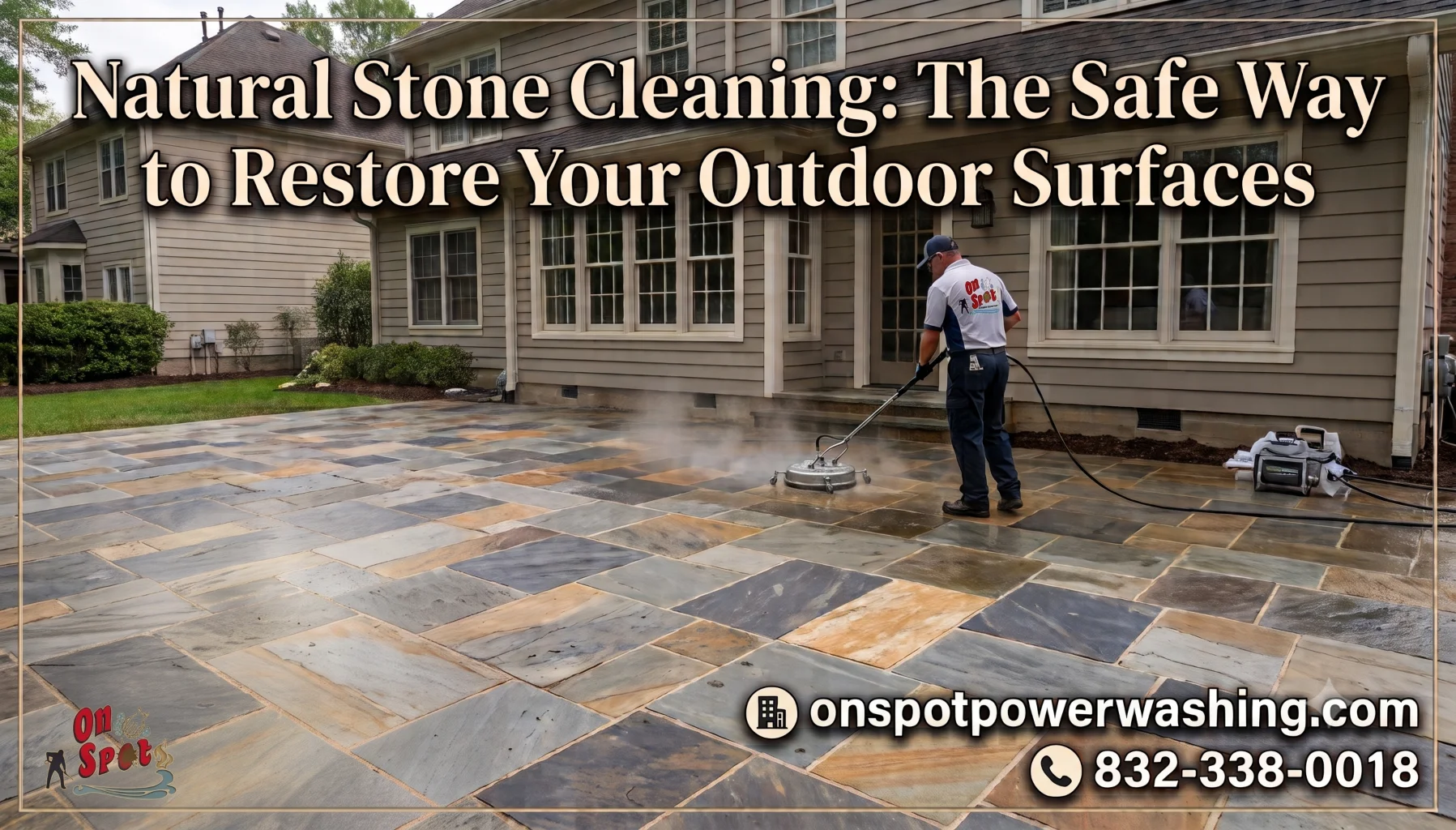
Natural stone is one of the most beautiful — and most misunderstood — outdoor surface materials in Fort Bend County homes. Travertine pool decks, limestone patios, slate walkways, and flagstone entertaining areas represent significant investments in both cost and aesthetic value. And yet they’re routinely cleaned incorrectly, damaged by well-intentioned homeowners using the wrong products, or left to deteriorate because the owner doesn’t know how to address the biological growth and staining that Texas’s subtropical climate relentlessly produces.
The core truth about natural stone cleaning is this: what works perfectly on concrete will permanently damage natural stone. The same high-pressure washing that restores a concrete driveway can etch travertine, dislodge limestone particles, and destroy the surface profile of sandstone. The bleach solution that kills algae on siding will discolor marble and chemically attack the calcium carbonate in travertine. Natural stone requires its own approach — and getting it wrong has consequences that can’t be undone.
⚠️ The Permanent Damage Risk — Read This First
Unlike concrete, which is highly resilient to cleaning errors, natural stone damage from incorrect cleaning is often irreversible. Acid-based cleaners (including vinegar, muriatic acid, and many consumer deck cleaners) permanently etch travertine and limestone. High-pressure washing can fracture surface layers of softer stones. Bleach causes lasting discoloration in marble and light-colored travertine. There is no restoration option for acid-etched natural stone short of full resurfacing or replacement. Always confirm cleaning products and methods are stone-safe before application.
The Most Common Natural Stone Surfaces in Fort Bend County Homes
Travertine
The most common natural stone pool deck and patio surface in Fort Bend County’s premium neighborhoods. Travertine is a form of limestone — highly porous, naturally textured, and particularly vulnerable to acid-based cleaners. Its characteristic pitted surface traps biological growth aggressively in Texas’s humidity. Requires pH-neutral cleaning and penetrating sealer for protection.
⚠ High sensitivity — pH-neutral onlyLimestone
Used for patios, garden paths, retaining walls, and exterior cladding. Limestone is calcium carbonate-based — which means it reacts chemically and irreversibly with any acidic substance, including common household cleaners, pool chemical splash, and even certain fertilizers. Requires specialist stone cleaning chemistry and careful post-cleaning sealing.
🔴 Very high sensitivity — professional recommendedSlate
Popular for walkways, stepping stones, and pool surrounds. Slate is more durable than travertine or limestone but still requires careful cleaning — high pressure can delaminate the surface layers that give slate its characteristic layered appearance. Avoid alkaline cleaners, which can damage slate’s surface sheen.
⚠ Moderate sensitivity — low pressure requiredFlagstone and Sandstone
Used for informal patios, garden stepping areas, and naturalistic outdoor designs. Variable hardness depending on the specific stone — some flagstone is quite soft and highly porous. Sandstone is particularly vulnerable to high-pressure washing, which can erode the surface and dislodge surface particles. Requires assessment before any cleaning treatment.
⚠ Variable sensitivity — assess before cleaningWhat Fort Bend County's Climate Does to Natural Stone
Natural stone in Fort Bend County’s subtropical environment faces a more aggressive contamination cycle than almost any other US climate. Understanding what accumulates on stone — and why — is essential for choosing the right cleaning approach:
- Black algae root penetration. Black algae is the most destructive biological threat to porous natural stone in Fort Bend County. Unlike green algae that sits on the surface, black algae sends root systems into the stone’s pores — anchoring itself physically into the material. Surface cleaning cannot remove it; the root system must be chemically treated with stone-safe biological killers before cleaning
- Calcium and mineral efflorescence. Fort Bend County’s hard water, pool chemical splash, and subsurface moisture movement deposits white calcium and mineral deposits on stone surfaces — particularly around grout joints and at the base of water features. These deposits require specific descaling treatment with stone-safe products
- Tannin staining from organic matter. Leaves, organic debris, and tree matter deposit tannins that penetrate and stain porous stone surfaces in Texas’s heat rapidly. These stains deepen over time and become progressively harder to remove the longer they remain
- Pool chemical damage. Chlorine and pH adjustment chemicals from pool splash and overflow attack calcium carbonate-based stones — particularly travertine and limestone — causing a slow chemical etching that compounds over years if the stone isn’t properly sealed and maintained
🪨 Why Sealed Stone Outperforms Unsealed Stone in Texas
Sealed natural stone and unsealed natural stone in Fort Bend County’s climate are dramatically different maintenance propositions. A penetrating stone sealer fills the stone’s pores, preventing biological material, pool chemicals, minerals, and tannins from penetrating the surface. Sealed stone cleans up with far less effort, resists staining, and slows biological growth re-establishment between cleanings. Unsealed stone absorbs everything — and becomes progressively more difficult and expensive to restore with each cleaning cycle.
The Right Way to Clean Natural Stone — Step by Step
Surface Assessment and Stone Identification
Before any cleaning begins, the stone type, sealer condition, contamination type, and damage level must be assessed. Different stones require different chemistry and pressure settings — what’s appropriate for slate is wrong for travertine. This assessment step is where most DIY cleaning errors occur: assuming all stone can be cleaned the same way.
Pre-Treatment with Stone-Safe Biological Cleaner
A pH-neutral biological treatment is applied to the stone surface and allowed to dwell for 15 to 30 minutes. This treatment penetrates the stone’s pores to kill biological root systems — particularly black algae — from within, rather than just removing surface growth. This step is critical; skipping it means biological growth re-establishes within weeks from the root systems left behind.
Targeted Stain Treatment
Specific stain types — tannin staining, mineral efflorescence, rust, or pool chemical marks — receive targeted pre-treatment with appropriate stone-safe chemistry before the main cleaning rinse. Each stain type requires a different treatment approach; applying the wrong treatment to the wrong stain type can set the stain deeper rather than removing it.
Low-Pressure Rinse (400–800 PSI)
The loosened biological growth and dissolved contamination is rinsed from the surface using low pressure (400–800 PSI depending on stone type) — dramatically lower than the 1,500–3,000 PSI used on concrete. Wide-angle nozzles prevent concentrated pressure damage. Grout joints are cleaned carefully to avoid dislodging mortar while still removing embedded contamination.
Post-Cleaning Sealer Application
After the stone is fully dry (24–48 hours), a penetrating stone sealer is applied to fill the stone’s pores and protect the newly cleaned surface. This is the most important long-term value step: sealed stone resists future contamination dramatically better, cleans more easily in subsequent cycles, and maintains its appearance significantly longer than unsealed stone in Fort Bend County’s environment.
What to Use — and What Never to Use — on Natural Stone
✓ Safe for Natural Stone
- ✓ pH-neutral stone cleaning solutions
- ✓ Stone-safe biological treatments
- ✓ Low-pressure water rinse (400–800 PSI)
- ✓ Soft-bristle brushes for agitation
- ✓ Penetrating stone sealers (post-cleaning)
- ✓ Stone-specific efflorescence remover
- ✓ Warm water rinse for light maintenance
✗ Never Use on Natural Stone
- ✗ Bleach or chlorine-based cleaners
- ✗ Vinegar or any acid-based product
- ✗ Standard pressure washing detergents
- ✗ Consumer deck or patio cleaners
- ✗ High-pressure washing (1,000+ PSI)
- ✗ Muriatic or hydrochloric acid
- ✗ Ammonia-based cleaning products
Natural Stone Surface Cleaning Guide by Type
| Stone Type | Safe PSI Range | Chemical Sensitivity | Sealing Priority |
|---|---|---|---|
| Travertine | 400–600 PSI max | 🔴 Acid destroys surface permanently | Critical — seal every 1–2 years |
| Limestone | 400–700 PSI max | 🔴 Extremely acid-sensitive — professional only | Critical — seal every 1–2 years |
| Marble | 300–500 PSI max | 🔴 Bleach causes permanent discoloration | Essential — professional restoration if damaged |
| Slate | 500–800 PSI max | ⚠ Moderate — avoid strong alkaline | Recommended — seal every 2–3 years |
| Flagstone (hard) | 600–900 PSI max | ⚠ Moderate — test area first | Recommended — seal every 2–3 years |
| Sandstone | 300–600 PSI max | 🔴 Very soft — high erosion risk | Critical — seal every 1 year |
| Granite (outdoor) | 800–1,200 PSI max | ✅ Most durable natural stone | Moderate — seal every 3–5 years |
✅ The Fort Bend County Natural Stone Maintenance Schedule
For most natural stone outdoor surfaces in Fort Bend County, the optimal maintenance cycle is: professional cleaning every 12 to 18 months, with sealer reapplication after each cleaning. Surfaces in high-exposure environments — pool deck travertine, shaded flagstone paths, or surfaces near irrigation systems — benefit from cleaning every 6 to 12 months to prevent black algae from establishing deep root penetration. Visual inspection every 6 months allows early intervention before contamination requires more aggressive treatment.
Frequently Asked Questions
Natural stone can be cleaned with water, but standard high-pressure washing is generally not appropriate. Most natural stone — including travertine, limestone, sandstone, and slate — is porous and relatively soft compared to concrete. High pressure can etch the surface, dislodge stone particles, damage grout joints, and strip any existing sealer. Professional natural stone cleaning uses low-pressure techniques (400–800 PSI) combined with pH-neutral stone-safe cleaning solutions rather than standard pressure washing.
Algae removal from natural stone requires a pH-neutral, stone-safe biological treatment — not bleach or acid-based cleaners, which damage stone surfaces. The correct approach is: apply a stone-safe biological cleaner, allow adequate dwell time (15–30 minutes), gently agitate with a soft brush, and rinse with low-pressure water. For deeply embedded algae or black algae that has penetrated the stone's pores, professional treatment with specialist stone restoration chemicals is required.
Travertine requires pH-neutral cleaning products specifically formulated for natural stone. Never use: bleach (causes discoloration and surface breakdown), vinegar or any acid-based cleaner (dissolves the calcium carbonate in travertine permanently), standard pressure washing detergents (usually alkaline or acidic), or consumer-grade deck cleaners. Safe options include pH-neutral stone soaps and professionally applied stone-safe biological treatments. After cleaning, travertine should be sealed with a penetrating stone sealer to protect the surface.
Natural stone outdoor surfaces in Fort Bend County should be professionally cleaned every 12 to 18 months at minimum, with inspection every 6 months. The region's subtropical humidity and year-round warmth accelerate biological growth on porous stone surfaces significantly faster than in drier climates. Pool deck travertine and shaded flagstone paths may require cleaning every 6 to 12 months to prevent biological growth from establishing deep root systems in the stone's pores.
Yes — sealing is the most important protective step after professional cleaning of any porous natural stone. A penetrating stone sealer fills the stone's pores, preventing water, biological material, pool chemicals, and staining agents from penetrating the surface. Sealed stone is dramatically easier to clean in subsequent cycles, resists staining, and slows biological growth re-establishment. Most natural stone outdoor surfaces in Fort Bend County's climate should be resealed every 1 to 3 years depending on exposure and foot traffic.
Professional Natural Stone Cleaning in Fort Bend County
On Spot Power Washing provides specialist natural stone cleaning and restoration throughout Richmond TX, Sugar Land, Katy, Cinco Ranch, and all of Fort Bend County. Stone-safe chemistry, low-pressure technique, sealer application available. Free estimates.
Get a Free Estimate 📞 832-338-0018