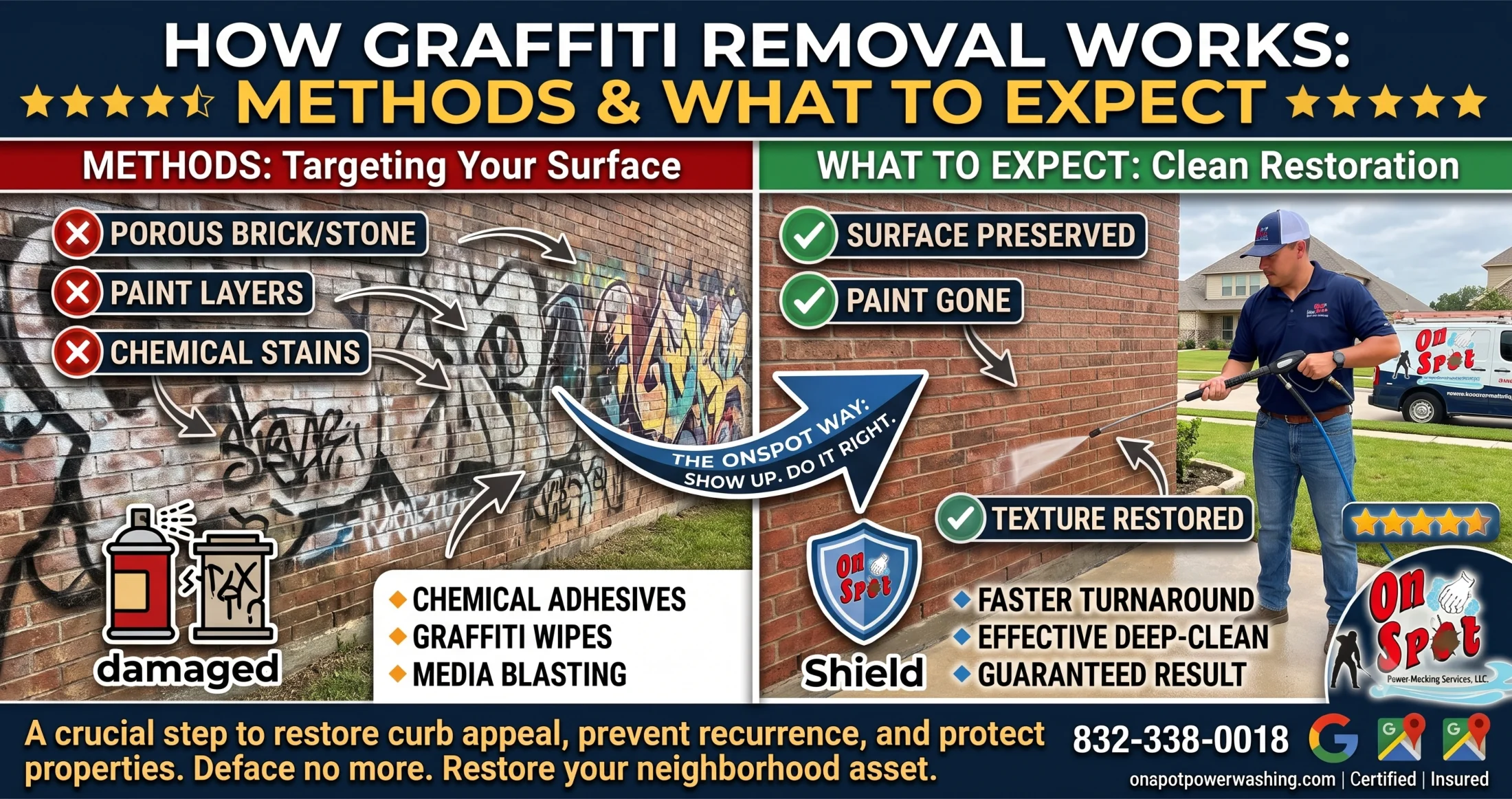
Graffiti is one of the most stressful discoveries a property owner can make — and in Fort Bend County’s rapidly growing commercial and residential corridors, it’s more common than most people expect. Whether it’s a tagged commercial building along US-90, a spray-painted fence in a Richmond TX neighborhood, or markings on a retaining wall, the immediate question is always the same: how do you get it off, and how completely can it be removed?
The answer depends on several factors — the type of paint used, the surface it was applied to, how long it has been sitting, and the removal method employed. This guide walks through every major graffiti removal method, what results you can realistically expect on different surfaces, and when DIY becomes insufficient and professional treatment is necessary.
⏱ Act Within 48 Hours — Always
Fresh graffiti (under 48 hours old) is dramatically easier to remove than cured paint. Most spray paint used for graffiti is lacquer or enamel-based — it begins chemically bonding with porous surfaces within hours and reaches full cure within 24 to 72 hours depending on temperature. In Fort Bend County’s heat, that bonding process is accelerated. Every hour you wait makes removal more difficult and more expensive.
The 4 Primary Graffiti Removal Methods
Chemical Solvent Treatment
Professional-grade graffiti removers use solvents that break down the chemical bond between the paint and the substrate. Applied as a gel or spray, the remover dwells on the surface, dissolving the paint from below. This is the most effective primary treatment for most surface types and paint types.
✅ Most effective — first-line treatmentHot Water Power Washing
High-temperature water (up to 200°F) combined with appropriate pressure flushes dissolved paint from the surface after chemical pre-treatment. Hot water is significantly more effective than cold water for graffiti removal — the heat continues breaking down paint bonds while the pressure lifts and removes residue.
✅ Used after chemical pre-treatmentAbrasive Blasting (Soda or Dry Ice)
For heavily porous surfaces like rough brick, textured concrete, or natural stone where chemicals may struggle to penetrate, abrasive blasting uses media (soda, dry ice, or fine sand) projected at high velocity to physically remove the paint layer without damaging the substrate underneath.
⚠️ Specialist technique — porous surfacesPaint-Over (Last Resort)
When removal is incomplete or the surface is too damaged to restore, painting over the graffiti matches the original surface color. This is a last resort — not a removal method — as it doesn’t eliminate the underlying staining and may require ongoing touch-ups if the surface is targeted again.
🚫 Last resort — not recommended firstWhat Results to Expect by Surface Type
No two surfaces respond the same way to graffiti removal. The porosity, texture, and coating of the surface are the primary determinants of how completely graffiti can be removed — and what method is appropriate:
| Surface | Removal Likelihood | Best Method | Notes |
|---|---|---|---|
| Sealed smooth concrete | ✅ Full removal likely | Chemical + hot water | Sealer prevents penetration — fresh graffiti lifts cleanly |
| Unsealed concrete (rough) | ⚠ Good removal likely | Chemical + pressure wash | Paint penetrates pores — may leave faint shadow on old graffiti |
| Smooth painted brick | ✅ Full removal likely | Chemical gel + hot water | Paint acts as barrier — excellent results when fresh |
| Unpainted porous brick | ⚠ Good — ghost shadow possible | Chemical + abrasive blast | Deep penetration into mortar joints is hardest to fully address |
| Metal surfaces (fencing, panels) | ✅ Full removal typical | Chemical solvent | Non-porous — paint sits on surface, comes off cleanly |
| Glass | ✅ Full removal | Razor scraper + solvent | Non-porous — easiest surface for complete graffiti removal |
| Wood (painted or stained) | ⚠ Likely — depends on age | Chemical + low pressure | High pressure can damage wood grain — careful technique required |
| Natural stone | 🔴 Partial — professional assessment needed | Specialist chemical + soda blast | Highly variable by stone type — requires professional evaluation |
| Stucco | ⚠ Good — technique sensitive | Low-pressure chemical treatment | High pressure damages stucco — gentle chemical approach only |
Why DIY Graffiti Removal Often Makes Things Worse
The instinct to grab a pressure washer or hardware store solvent and attack graffiti immediately is understandable — but without the right products, technique, and equipment, amateur removal attempts frequently cause more damage than the graffiti itself.
- Wrong solvents etch surfaces. Many consumer-grade paint removers contain acids that damage concrete, etch natural stone, and strip protective coatings from brick and metal — leaving permanent damage that’s more visible than the original graffiti
- Excessive pressure spreads the stain. High-pressure water applied without chemical pre-treatment doesn’t remove graffiti — it spreads the dissolved paint into a larger, lighter, harder-to-remove stain across the surface
- Wire brushes damage porous surfaces. Scrubbing brick, stucco, or textured concrete with abrasive brushes damages the surface profile permanently — creating rough areas that hold future contamination faster
- Incomplete removal invites repeat tagging. Research on graffiti vandalism consistently shows that partially removed graffiti — ghost shadows, faded tags — is treated by taggers as a “clean” surface that signals the property isn’t being monitored
💡 The Deterrent Effect of Fast, Complete Removal
Properties that remove graffiti completely within 24 to 48 hours are statistically less likely to be targeted again than properties where graffiti remains visible for days or weeks. Fast, thorough removal sends a clear signal that the property is actively monitored — and repeat taggers target passive properties, not active ones. Complete professional removal is both a cleanup and a deterrent strategy.
What to Do Immediately After Discovering Graffiti
- Photograph it immediately — date-stamped photos for insurance claims, police reports, and before/after documentation
- File a police report — required by most insurance policies for graffiti damage claims; Fort Bend County Sheriff’s Department accepts reports online
- Do not attempt pressure washing without chemical pre-treatment — water alone spreads and sets paint deeper into the surface
- Do not use consumer paint stripper or bleach — most will damage the surface and may make professional removal harder
- Call a professional immediately — every hour matters in Fort Bend County’s heat, where paint cures faster than in cooler climates
- Consider anti-graffiti coating after removal — clear protective coatings make future graffiti dramatically easier to remove and are a smart investment for repeatedly targeted surfaces
✅ After Removal: Anti-Graffiti Coating
The most cost-effective long-term strategy for surfaces that have been tagged — or that are in areas with a history of graffiti — is applying a professional anti-graffiti coating after removal. These clear sealers create a sacrificial layer that prevents paint from bonding with the substrate. Future graffiti wipes or washes off with minimal effort and cost, and the coating is reapplied after each cleaning. Cost: $100–$300 for most surfaces. Value: dramatically reduced future removal costs.
Frequently Asked Questions
In most cases, yes — especially when addressed promptly. Fresh graffiti (less than 48 hours old) on concrete and brick can typically be fully removed using chemical degreasers and hot water power washing. Older graffiti that has had days or weeks to cure may leave a faint ghost shadow, particularly on porous surfaces. On smooth, sealed concrete or painted surfaces, complete removal is almost always possible regardless of age.
As quickly as possible — ideally within 24 to 48 hours of discovery. Fresh graffiti is significantly easier and less expensive to remove than cured paint. There is also a documented vandal deterrent effect: properties that consistently remove graffiti quickly are statistically less likely to be targeted again than properties where graffiti is left in place for weeks.
When performed by a professional using the correct chemicals and pressure for the specific surface, graffiti removal should not damage the substrate. Amateur attempts using the wrong solvents or excessive pressure can etch concrete, strip paint from brick, or damage surface coatings permanently. This is why professional assessment of the surface type before treatment is critical.
Pressure washing alone is rarely sufficient for graffiti removal. Most spray paint bonds chemically with the surface substrate, meaning water pressure alone cannot break that bond. Effective graffiti removal combines chemical pre-treatment — a solvent that breaks down the paint's bond with the surface — followed by hot water power washing to lift and flush the released paint. The chemical component is what does the primary work; pressure washing completes the removal.
Professional graffiti removal in the Richmond TX and Fort Bend County area typically starts at $150 to $300 for a small area on a standard surface. Larger coverage areas, more complex surfaces like natural stone or historic brick, or deeply set paint that requires multiple treatment cycles will cost more. On Spot Power Washing provides free estimates — call 832-338-0018.
Graffiti on Your Property? Act Now.
On Spot Power Washing provides professional graffiti removal throughout Richmond TX, Sugar Land, Katy, and all of Fort Bend County. Fast response, free estimates, fully insured.
Get a Free Estimate 📞 832-338-0018