
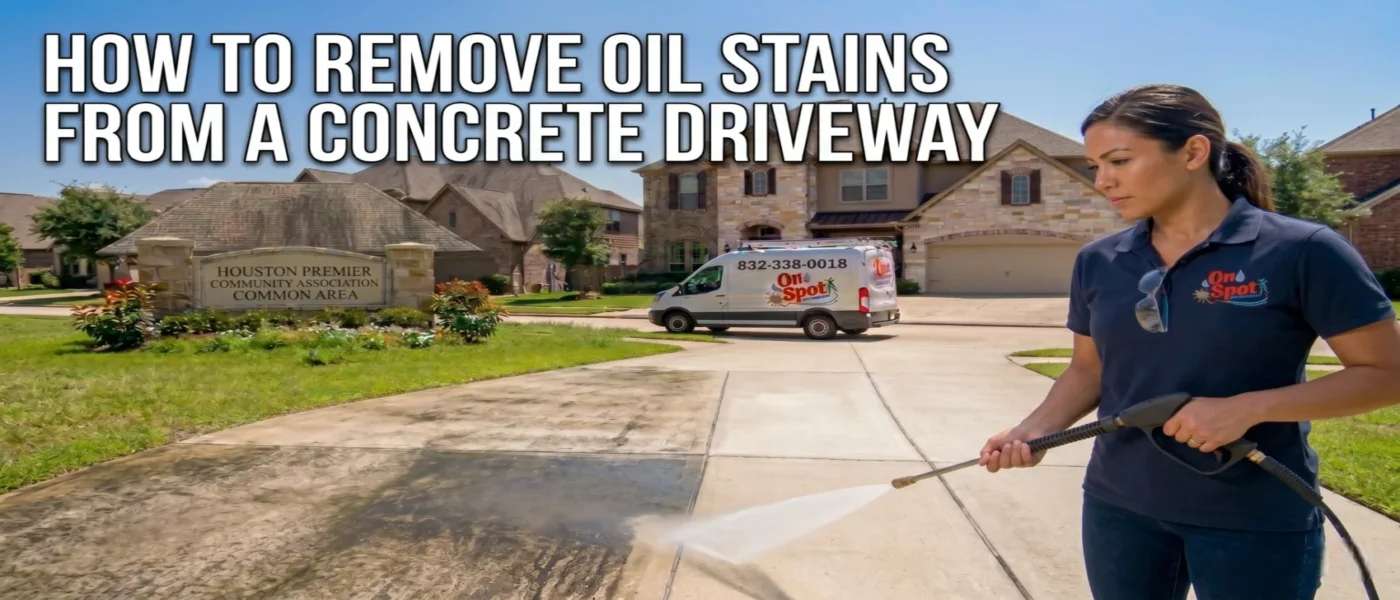
It happens to almost every homeowner eventually — a dripping car, a leaking lawn mower, or a delivery truck that parks in the wrong spot leaves an ugly dark oil stain right in the middle of your concrete driveway. In Richmond TX, Sugar Land, Katy, and across Fort Bend County, where HOA inspections are common and curb appeal matters, that stain becomes a problem fast.
The good news: oil stains on concrete are not a lost cause. The bad news: how successfully you can remove them depends almost entirely on how quickly you act and which method you use. This guide walks you through everything — from first-response treatment for fresh spills to professional options for stains that have been sitting for months.
Time Is the Most Important Factor
Oil begins penetrating concrete within minutes of contact because concrete is highly porous. Within 24–48 hours it reaches deeper layers where surface cleaning becomes much less effective. Within weeks or months, it oxidizes and chemically binds with the concrete — making complete removal very difficult. The single most important thing you can do is act fast
Understanding Oil Stains on Concrete: 3 Stages
Fresh Stain
0–24 hours old
Oil is still on or near the surface. Highest chance of complete removal with DIY methods.
✅ Best outcome possibleSet Stain
1 day to a few weeks old
Oil has penetrated deeper layers. DIY methods help but professional treatment delivers better results.
⚠ Partial to good removalOld / Deep Stain
Months or years old
Oil has oxidized and bonded with concrete. Professional hot water power washing with pre-treatment is required.
🔧 Significant improvementStep-by-Step: How to Remove Oil Stains from Concrete
Act Immediately — Absorb the Fresh Oil
The moment you spot a fresh oil spill, cover it completely with an absorbent material. Options include cat litter, baking soda, cornstarch, or sawdust. Apply a thick layer over the entire stain, press down slightly, and let it sit for 30 to 60 minutes to draw the oil up from the concrete’s surface before it soaks deeper.
→ Tip: Do NOT rinse with water first — water will push the oil deeper into the concrete’s pores.
Sweep Up the Absorbent Material
Once the absorbent material has done its job, sweep it up completely and dispose of it in a sealed bag. Do not hose it into the storm drain — oil-contaminated material is an environmental hazard and illegal to dump in storm drainage in Fort Bend County.
→ Tip: Bag the used cat litter or baking soda and check your municipality’s guidelines for disposal of oil-contaminated materials.
Apply a Degreaser or Heavy-Duty Dish Soap
Apply a commercial concrete degreaser (available at any hardware store) or pour full-strength heavy-duty dish soap directly onto the stain. Work it into the concrete using a stiff-bristle scrub brush in a firm circular motion — not a wire brush, which can scratch the concrete surface. Let the solution dwell on the stain for 10 to 15 minutes without drying out.
→ Tip: Keep the degreaser wet by misting lightly with water if it starts to dry. Dry degreaser loses effectiveness.
Scrub Thoroughly and Rinse
After the dwell time, scrub vigorously again and then rinse with a garden hose or pressure washer. For a fresh stain, this single cycle may be sufficient. For a stain that is a few days old, repeat the degreaser application and scrubbing 2 to 3 times before rinsing — each cycle will lift additional oil from the concrete’s pores.
→ Tip: Rinse from the outside edges of the stain inward to avoid spreading the lifted oil to clean concrete areas.
Apply a Poultice for Deep-Set or Old Stains
For stains that are weeks or months old and resist degreaser treatment, a poultice can draw oil back up from deep within the concrete. Mix powdered laundry detergent or trisodium phosphate (TSP) with water into a thick paste. Spread a half-inch layer over the stain, cover with plastic wrap, tape down the edges, and leave for 24 hours. The paste draws oil up as it dries. Remove and rinse — repeat if needed.
→ Tip: TSP is highly effective but requires gloves and eye protection — it’s a caustic cleaning agent. Available at hardware stores.
For Stubborn Stains — Call a Professional
If the stain has resisted multiple DIY treatments, or if it covers a large area, professional hot water power washing with commercial-grade degreaser pre-treatment is the most effective remaining option. The combination of high-temperature water (up to 200°F), high pressure, and professional degreaser chemistry breaks down oil compounds that consumer products simply cannot reach.
→ On Spot Power Washing offers professional driveway oil stain treatment throughout Richmond TX, Sugar Land, Katy, and Fort Bend County. Call 832-338-0018 for a free estimate.
Best Products for Oil Stain Removal on Concrete
Not all cleaning products work equally on oil-stained concrete. Here’s how the most commonly available options compare:
| Product | Best For | Effectiveness | Notes |
|---|---|---|---|
| Cat litter / baking soda | Fresh spills (first response) | High (fresh only) | Absorbs oil before it penetrates — must act immediately |
| Heavy-duty dish soap | Fresh to 2-day-old stains | High (fresh) | Dawn or equivalent — cheap, effective, safe for concrete |
| Commercial concrete degreaser | Fresh to 2-week-old stains | High | Zep, Krud Kutter, or similar — best DIY option for most stains |
| Trisodium phosphate (TSP) | Set or older stains | High | Caustic — requires gloves and eye protection; very effective |
| Poultice paste (TSP + water) | Deep-set stains weeks to months old | Medium–High | Draws oil up from concrete pores over 24 hours; requires patience |
| Muriatic acid | Very old, heavily oxidized stains | Medium | Highly hazardous — neutralizes stain but can etch concrete; professional use only |
| Cold water pressure washing alone | Surface dirt only | Low for oil | Oil is hydrophobic — water pressure alone does not lift oil effectively |
| Professional hot water power washing + degreaser | All stain ages — best available option | ⭐ Highest | Commercial-grade heat + chemistry; far exceeds any DIY method for set stains |
DIY vs. Professional Oil Stain Removal
DIY Treatment
- •Works well on fresh stains treated within 24 hours
- •Cost: $5–$30 in products
- •Time: 1–3 hours plus 24-hour poultice wait
- •Consumer products limited in penetration depth
- •Multiple repeat treatments often needed
- •Old stains frequently resist DIY methods
- •Risk of spreading stain if rinsed incorrectly
- •Results vary significantly by stain age and depth
Professional Treatment
- ✓Effective on fresh and deep-set stains of all ages
- ✓Cost: $75–$200 for full driveway cleaning
- ✓Time: 1–2 hours, same-day result
- ✓Commercial-grade hot water breaks oil bonds
- ✓Professional degreasers penetrate deeper than consumer products
- ✓Best available option for old or stubborn stains
- ✓Full driveway cleaned — not just the stain
- ✓HOA-compliant result with professional finish
⚠️ Honest Expectation Setting
Even professional treatment cannot guarantee 100% removal of very old, deep, or oxidized oil stains. If a stain has been on your concrete for more than 6–12 months in Fort Bend County’s climate — where heat and humidity accelerate the oxidation process — expect significant improvement but prepare for the possibility that a faint shadow may remain. We will always give you an honest assessment before we start.
What Causes Oil Stains on Concrete Driveways?
Understanding the source helps you prevent future staining. The most common causes we see on Fort Bend County driveways include:
-
🛢️Engine oil leaks The most common cause — even a slow drip creates a significant stain over weeks.
-
🔴Power steering fluid leaks Typically leaves a reddish-tinged stain on the concrete surface.
-
🟤Transmission fluid Deep reddish-brown staining — often mistaken for engine oil but more deeply pigmented.
-
🌿Lawn mower and small engine leaks Common in the garage and near the driveway edge — often go unnoticed until a stain forms.
-
🚚Delivery truck or contractor vehicle drips Often appear as multiple small drops in a line — a telltale sign of a passing vehicle leak.
-
🔥Grill drippings Cooking grease left on the driveway from outdoor cooking or moving a grill — surprisingly common.
-
🧴Petroleum-based products Rust inhibitors, chain lubricants, and other maintenance products commonly used in garages and driveways.
How to Prevent Future Oil Stains
- Address vehicle leaks promptly. A slow drip creates a significant stain within days. If your vehicle is leaving spots, have it inspected immediately.
- Use a drip pan or garage mat. Place an absorbent mat or metal drip pan under parked vehicles that are known to drip. Disposable oil drip pads are available at any auto parts store.
- Apply a concrete sealer. A quality penetrating concrete sealer significantly reduces the porosity of your driveway surface, making oil penetration much slower and removal easier. Sealed concrete should be re-treated every 2–3 years in Fort Bend County’s climate.
- Clean spills immediately. Keep a bag of cat litter or a container of baking soda in your garage specifically for immediate oil spill response.
- Schedule regular professional cleaning. Annual driveway pressure washing removes light oil residue, traffic film, and organic buildup before it can set and accumulate into a serious stain problem.
Frequently Asked Questions
Fresh oil stains can often be removed completely with prompt treatment and the right products. Old or deep-set stains that have had months or years to penetrate the concrete may not fully disappear — but professional treatment with hot water power washing and commercial degreasers can produce a very significant improvement in most cases. The older the stain, the more realistic your expectations for complete removal should be.
Standard cold water pressure washing alone is not very effective on oil stains because oil is hydrophobic — it repels water. Professional hot water power washing combined with commercial degreaser pre-treatment is the most effective approach available. The heat breaks down the oil's molecular bonds while the degreaser lifts it from the concrete's pores — far more effectively than cold water and pressure alone.
For fresh stains, cat litter or baking soda applied immediately to absorb the oil, followed by dish soap or a commercial degreaser scrubbed in with a stiff brush, works very well. For older stains, a poultice made from powdered laundry detergent or trisodium phosphate mixed with water into a thick paste, applied over the stain and left for 24 hours under plastic wrap, can draw oil back up from deeper in the concrete.
Oil begins penetrating concrete within minutes of contact because concrete is highly porous. After 24 to 48 hours, oil has typically reached deeper layers where surface cleaning becomes much less effective. After weeks or months, the stain oxidizes and binds chemically with the concrete, making complete removal very difficult. In Fort Bend County's heat and humidity, this oxidation process is accelerated compared to cooler climates. Acting within the first hour gives you the best chance of full removal.
Professional driveway cleaning in the Richmond TX and Fort Bend County area typically ranges from $75 to $200 for a standard residential driveway, depending on size and condition. Oil stain pre-treatment is included in On Spot Power Washing's driveway service. We always provide a free, no-obligation estimate before any work begins. Call 832-338-0018 or request online at onspotpowerwashing.com.
Need Professional Driveway Cleaning in Richmond TX?
On Spot Power Washing handles oil stain pre-treatment as part of every driveway cleaning. Serving Richmond, Sugar Land, Katy, Cinco Ranch, and all of Fort Bend County. Free estimates, same-week availability
📞 Call now: (832) 338-0018