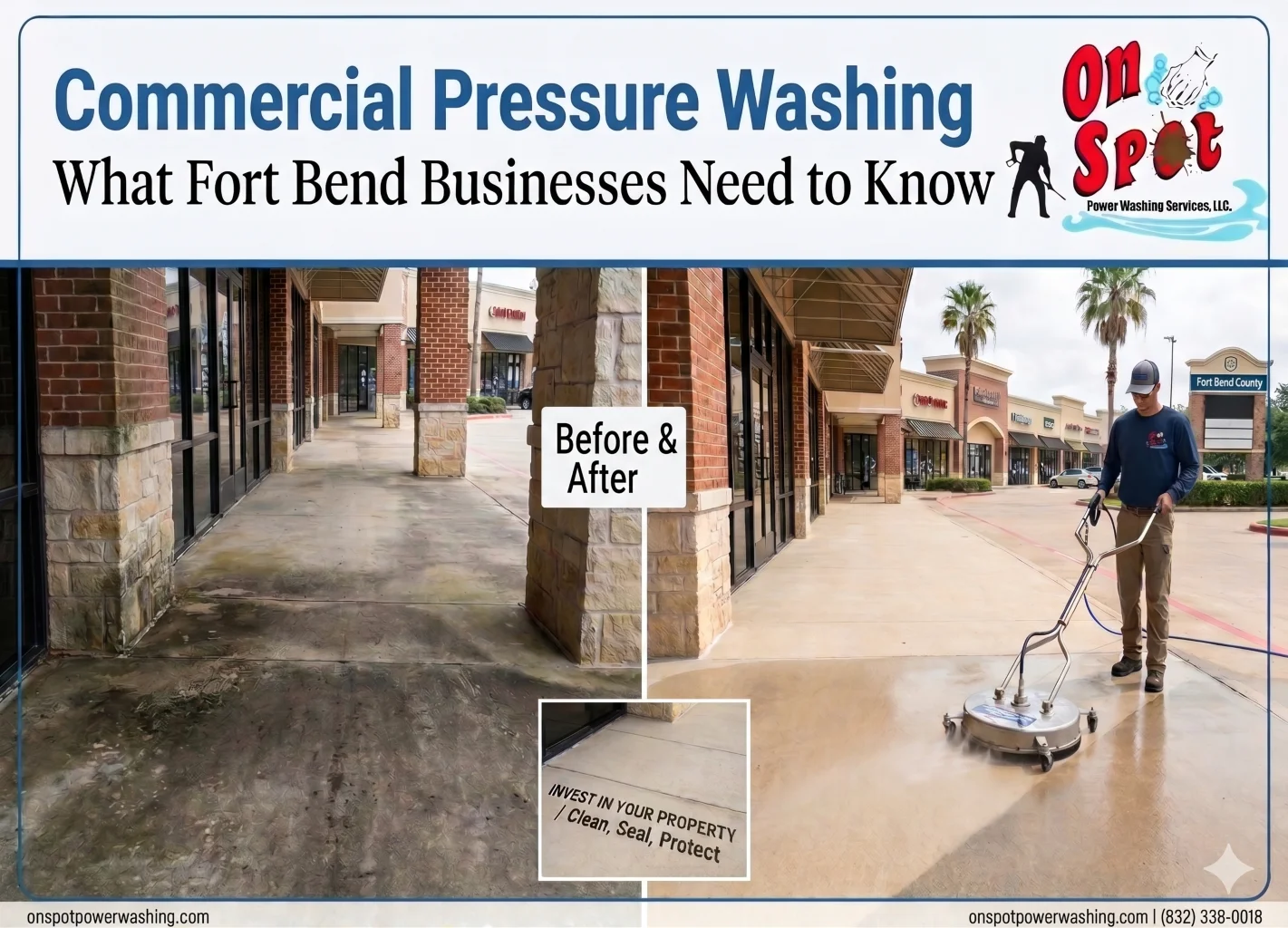
Your commercial property’s exterior is the first thing every customer, client, vendor, and potential employee sees before they walk through your door. In Fort Bend County — one of the fastest-growing business corridors in Texas, spanning Richmond, Sugar Land, Katy, and Missouri City — competition for customer attention is intense and first impressions happen in seconds.
A clean, well-maintained commercial exterior signals professionalism, operational pride, and attention to detail. A stained, algae-covered, or grimy exterior signals the opposite — and in Fort Bend County’s subtropical climate, where biological growth establishes year-round, commercial properties deteriorate visibly faster than almost anywhere else in the country.
Commercial pressure washing is not the same as residential cleaning. The surfaces are larger, the compliance stakes are higher, the scheduling constraints are tighter, and the consequences of neglect are felt directly in customer perception and revenue. This guide covers everything Fort Bend County businesses need to know.
Why Commercial Exterior Cleaning Is Different From Residential
Homeowners clean their driveways and siding primarily for curb appeal and HOA compliance. For commercial properties, the stakes are significantly higher across multiple dimensions:
- Customer perception drives revenue. Research consistently shows that consumers make subconscious judgments about a business’s quality and trustworthiness based on the physical appearance of the property before they ever interact with staff or product. A dirty storefront or stained entryway is a conversion killer before the customer even enters.
- Liability exposure is greater. Commercial properties carry significantly higher slip-and-fall liability than residential ones — higher foot traffic, greater legal scrutiny, and larger potential damage awards. Algae-covered walkways, stained entryways, and slippery parking area surfaces all represent active liability risks.
- Compliance requirements apply. Depending on your business type, exterior cleanliness may be subject to health code inspection, ADA compliance review, or commercial lease requirements. Restaurants, healthcare facilities, and food service businesses in particular face exterior cleanliness standards that residential properties do not.
- Square footage is larger and more complex. Commercial cleaning typically involves multiple surface types — concrete, glass, brick, metal panels, awnings, signage — each requiring specific pressure settings, detergents, and techniques. Consumer-grade equipment isn’t adequate for commercial-scale work.
📍 Fort Bend County Commercial Growth Context
Fort Bend County added over 40,000 residents in 2023 alone and consistently ranks among the fastest-growing counties in the United States. With that growth comes a rapidly expanding commercial landscape — and increasingly discerning consumers who have more choices than ever. In this environment, a business’s physical presentation is a competitive differentiator, not just a maintenance checkbox.
Which Fort Bend County Businesses Need Regular Commercial Pressure Washing?
Restaurants and Food Service
Drive-throughs, dumpster enclosures, grease-stained entryways, and kitchen exhaust areas accumulate grease, organic matter, and biological growth at an accelerated rate. Health code inspections evaluate exterior cleanliness. Drive-through lanes and entryways are the first thing customers see.
🗓 Recommended: Monthly to QuarterlyRetail Storefronts and Strip Centers
Glass storefronts, sidewalks, awnings, and entryways are customer-facing surfaces that reflect directly on your brand. In Fort Bend County’s high-traffic retail corridors along US-90, Highway 6, and FM 1093, appearance directly affects foot traffic and customer conversion rates.
🗓 Recommended: Monthly to Bi-MonthlyOffice Buildings and Corporate Parks
Building exteriors, entryways, parking structures, and common areas reflect on tenant businesses as much as on building management. Fort Bend County’s corporate parks along the Grand Parkway and US-59 corridors compete for premium tenants who expect premium property maintenance.
🗓 Recommended: Quarterly to Semi-AnnualMedical and Healthcare Facilities
Patient and visitor perception of cleanliness begins in the parking lot and at the front entrance — before they enter the building. Healthcare facilities also face unique regulatory scrutiny around exterior cleanliness, and the population they serve is often particularly sensitive to visible contamination.
🗓 Recommended: Monthly to QuarterlyAuto Dealerships and Service Centers
Vehicle dealerships and service centers have massive concrete areas, service bays, and showroom glass that accumulate oil, tire marks, and automotive fluids continuously. A clean lot signals a quality operation — and automotive consumers make purchase decisions at least partly on the perception of the facility.
🗓 Recommended: MonthlyHotels and Hospitality Properties
Online reviews frequently mention property appearance and exterior cleanliness. Hotel parking areas, entryways, pool decks, and exterior corridors are photographed and shared constantly by guests. In Fort Bend County’s growing hospitality market, review ratings directly impact booking rates.
🗓 Recommended: Monthly to Quarterly6 Business Benefits of Regular Commercial Pressure Washing
Drives Customer Confidence Before They Enter
Studies on consumer behavior consistently show that physical environment cleanliness is a primary trust signal — ranking alongside online reviews in influencing purchase decisions. A clean commercial exterior tells customers before they enter that you care about your operation, your product, and their experience. A dirty exterior raises doubt before a single word is exchanged.
Reduces Liability from Slip-and-Fall Accidents
Algae and biological growth on commercial walkways, parking areas, and entryways creates dangerous slip-and-fall conditions — particularly during and after Fort Bend County’s frequent rain events. Commercial properties face significantly higher legal exposure than residential ones for premises liability claims. Documented regular cleaning creates a record of proactive hazard management that is valuable in defending any liability claim.
Supports Health Code and Lease Compliance
Restaurants and food service businesses face health code requirements that include exterior areas — particularly dumpster enclosures, drive-throughs, and loading docks. Commercial leases frequently include exterior maintenance requirements that, if violated, can trigger lease remedies. Regular documented cleaning satisfies both categories proactively and creates a defensible record if compliance questions arise.
Extends the Life of Expensive Commercial Surfaces
Commercial concrete, brick, glass storefronts, metal cladding, and parking lot surfaces represent substantial capital investments. Biological growth, chemical contamination, and organic buildup accelerate deterioration of all of these materials. Regular professional cleaning at a fraction of repair costs extends the service life of commercial surfaces — reducing capital expenditure requirements and protecting property asset value.
Demonstrates Environmental Responsibility
Professional commercial pressure washing uses controlled water volumes, biodegradable detergents, and proper wastewater containment — significantly more environmentally responsible than DIY cleaning with uncontrolled runoff. For businesses with sustainability commitments, documented professional cleaning demonstrates responsible property management to stakeholders, customers, and regulatory bodies.
Protects and Enhances Property Asset Value
For commercial property owners, building condition is a key driver of assessed value, lease rates, and marketability. Consistent exterior maintenance documentation is a positive factor in commercial property appraisals and due diligence reviews. A well-maintained commercial exterior commands higher lease rates and attracts higher-quality tenants than comparable properties with visible deferred maintenance.
What Commercial Surfaces Does Professional Cleaning Cover?
| Surface / Area | Cleaning Method | Recommended Frequency | Key Issues Addressed |
|---|---|---|---|
| Building exterior (brick, stucco, panels) | Soft wash | ⚠ Quarterly | Mold, algae, environmental film, biological streaking |
| Glass storefront and windows | Purified water system | 🔴 Monthly | Hard water deposits, pollen film, fingerprints, environmental grime |
| Concrete walkways and entryways | Pressure washing | ⚠ Quarterly | Algae, mold, gum, traffic film, biological slip hazards |
| Parking lot and parking structure | Hot water pressure washing | ✅ Quarterly to Semi-Annual | Oil stains, tire marks, grease, organic buildup |
| Drive-through lanes | Hot water pressure washing | 🔴 Monthly | Grease, food debris, organic buildup, slip hazards |
| Dumpster enclosures | Hot water + degreaser | 🔴 Monthly | Organic waste residue, grease, odor-causing bacteria |
| Awnings and canopies | Low-pressure soft wash | ⚠ Quarterly | Mold, pollen, bird deposits, environmental staining |
| Loading docks and service areas | Hot water pressure washing | 🔴 Monthly to Quarterly | Oil, hydraulic fluid, organic matter, compliance requirements |
| Exterior signage | Low-pressure / detail cleaning | ✅ Semi-Annual | Biological growth, bird deposits, environmental film |
Scheduling Commercial Cleaning Around Business Operations
One of the most common concerns Fort Bend County business owners raise about commercial pressure washing is disruption. The answer is straightforward: professional commercial cleaning is scheduled around your operations, not the other way around.
On Spot Power Washing accommodates off-hours scheduling for all commercial clients — including early morning start times before retail opening, evening work after restaurant close, and weekend scheduling for office properties where weekday disruption must be avoided. Here’s how we approach scheduling for different business types:
- Retail storefronts: Early morning before opening (5–8 AM) — sidewalks and entryways are dry and ready when the first customer arrives
- Restaurants: Late evening after close or early morning before kitchen prep begins — avoids interference with dining service and health inspection windows
- Office buildings: Weekend scheduling or early morning weekday start — common areas, parking structures, and building exteriors are cleaned without disrupting tenant operations
- Healthcare facilities: Scheduled during lowest patient traffic periods — typically early weekend mornings for maximum safety and minimal disruption
- Auto dealerships: Early morning before the sales floor opens — lot areas cleaned and dry before vehicle movement and customer arrival
✅ The Fort Bend County Commercial Cleaning Standard
In a county growing as fast as Fort Bend, the bar for commercial property presentation is rising every year. New developments along the Grand Parkway, US-59, and Highway 90 corridors set a high standard — and established businesses that don’t maintain their exterior appearance lose competitive ground to newer, cleaner-looking competitors. Scheduled commercial pressure washing is no longer a premium service for large corporations — it’s a baseline maintenance expectation for any Fort Bend County business that takes its customer experience seriously.
Frequently Asked Questions
Most commercial properties in Fort Bend County benefit from professional pressure washing every 3 to 6 months. High-traffic retail storefronts, restaurants, and properties with large parking areas may need monthly or quarterly cleaning. Office buildings and light commercial properties with moderate foot traffic typically maintain good appearance on a quarterly or semi-annual cleaning schedule. Fort Bend County's subtropical climate accelerates biological growth year-round, making more frequent cleaning necessary than in drier climates.
Yes — professional commercial pressure washing contractors routinely schedule work during early morning hours, evenings, or weekends to avoid disrupting business operations and customer traffic. On Spot Power Washing accommodates off-hours scheduling for all commercial clients in Fort Bend County. This is especially important for retail storefronts, restaurants, and healthcare facilities where customer access must remain uninterrupted.
Professional commercial pressure washing covers: building exteriors (brick, stucco, metal panels, glass storefronts), parking lots and parking garages, concrete walkways and entryways, loading docks, drive-throughs, dumpster enclosures, signage, awnings, and exterior common areas. Different surfaces require different pressure settings and techniques — a qualified commercial contractor adjusts approach based on each surface type.
Yes. Algae and biological growth on commercial walkways, entryways, and parking areas creates slip-and-fall hazards that can result in ADA violations and health code citations depending on the business type. Restaurants and food service businesses in particular face health code requirements related to exterior cleanliness of entryways, dumpster areas, and drive-throughs. Regular professional cleaning addresses these compliance requirements proactively.
Commercial pressure washing pricing in Fort Bend County varies significantly based on the size of the property, number of surfaces, frequency of service, and level of buildup. Small retail storefronts typically start at $150 to $400 per visit. Larger commercial properties, parking lots, and multi-building complexes are priced based on square footage and service scope. On Spot Power Washing provides free commercial estimates — call 832-338-0018 or request online.